Virtual Dice for Board Games and RPGs: A Complete Guide
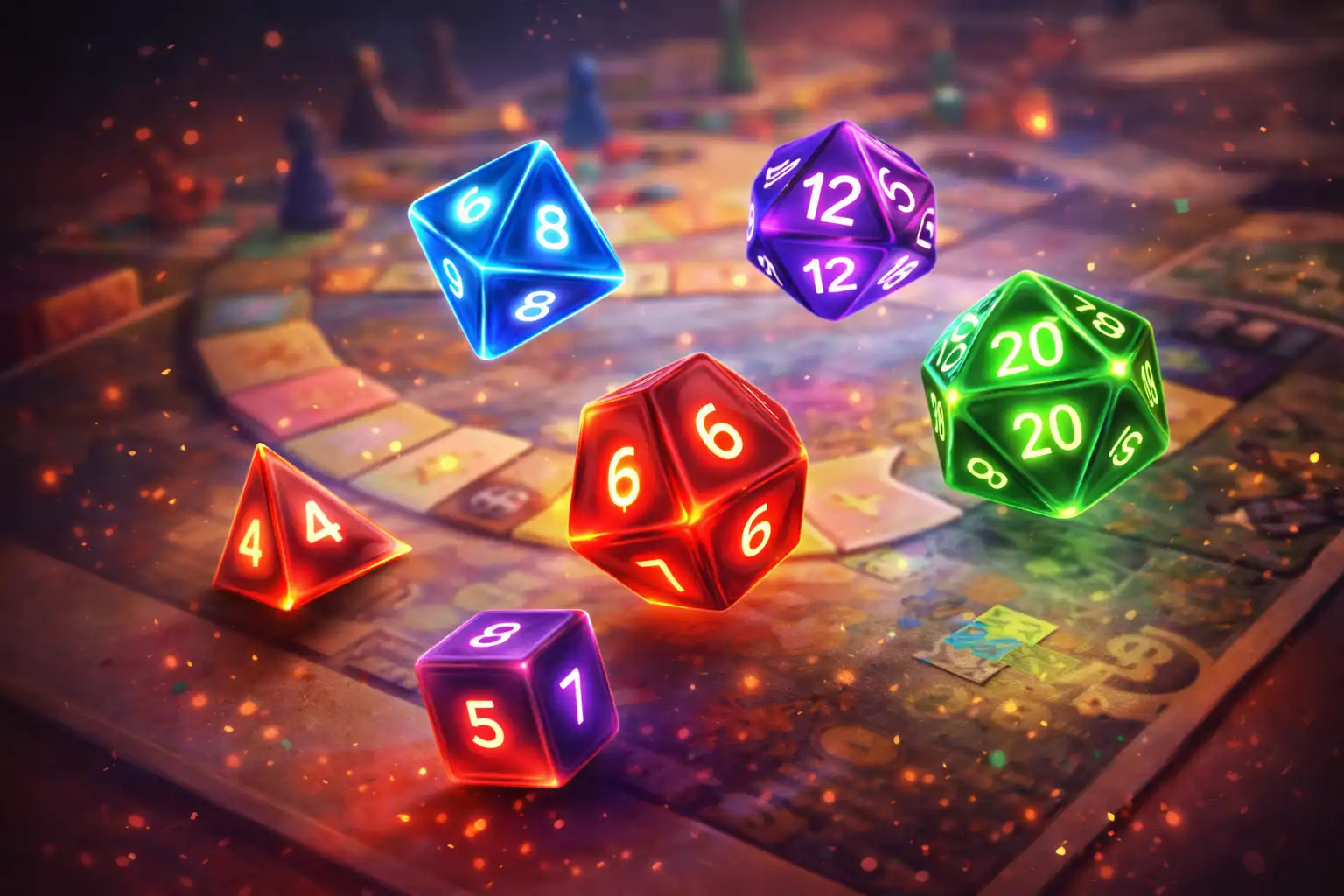
Table of Contents
Whether you are running a Dungeons & Dragons campaign, playing a board game online with friends, or settling a debate about who does the dishes, dice are a fundamental tool for introducing randomness. I still remember losing a full set of polyhedral dice during a move a few years back and realizing just how much I relied on those little things. Virtual dice rollers bring that same experience to your browser with realistic physics, multiple dice types, and mathematically guaranteed fairness.
1. Why Use Virtual Dice?
Physical dice are great, but they are not always practical:
- Remote play: When playing tabletop RPGs or board games online, everyone needs to see and trust the same dice roll. A shared virtual dice roller eliminates the "I swear I rolled a 20" problem.
- Convenience: No need to carry a bag of dice. Your phone or laptop gives you access to every type of die you could ever need.
- Fairness: Physical dice can be weighted, chipped, or have manufacturing defects that create subtle biases. Virtual dice powered by cryptographic randomness are provably fair.
- Multiple dice: Need to roll 8d6 for a fireball spell? Virtual dice handle any number of dice with automatic sum calculation, which is much faster than counting physical dice.
- Noise: Rolling physical dice on a table at 2 AM during a late-night gaming session can disturb others. Virtual dice are silent (or can play satisfying sound effects at your chosen volume).
- Record keeping: Virtual dice rollers can maintain a history of all rolls, useful for verifying results and settling disputes.
2. Types of Dice: From D4 to D100
Tabletop gaming uses a variety of polyhedral dice, each identified by the number of faces:
D4 (Tetrahedron): A four-sided die shaped like a pyramid. Used in D&D for dagger damage and small healing spells. The D4 is notorious among tabletop gamers for being painful to step on (it always lands point-up).
D6 (Cube): The standard six-sided die familiar to everyone. Used in countless board games (Monopoly, Yahtzee, Risk) and in RPGs for weapon damage, ability scores, and many other rolls.
D8 (Octahedron): An eight-sided die used in D&D for weapons like longswords and for medium healing spells.
D10 (Pentagonal trapezohedron): A ten-sided die numbered 0-9. Two D10s together form a D100 (percentile dice), with one die representing the tens digit and the other the ones digit.
D12 (Dodecahedron): A twelve-sided die used for heavy weapons like greataxes in D&D. Honestly, the D12 might be the most underappreciated die in the standard set — it deserves more love than it gets.
D20 (Icosahedron): The iconic twenty-sided die. In D&D and many other RPGs, the D20 determines the success or failure of virtually every action: attacks, skill checks, saving throws, and more. Rolling a natural 20 (a "critical hit") is one of the most exciting moments in tabletop gaming.
D100 (Percentile): Achieved by rolling two D10s, giving a range of 1-100. Used for random encounter tables, treasure generation, and any situation requiring a percentage roll.
3. How Virtual Dice Rollers Work
A well-built virtual dice roller combines two elements: mathematically fair randomness and a satisfying visual experience.
The randomness: For each die roll, the tool generates a cryptographically secure random number using the browser's crypto.getRandomValues() API. This number is mapped to the die's face range. For a D20, the random number is mapped to a value between 1 and 20, with each value having exactly equal probability (5% per face).
// Fair dice roll using cryptographic randomness
function rollDie(sides) {
    const array = new Uint32Array(1);
    crypto.getRandomValues(array);
    return (array[0] % sides) + 1;
}

// Roll a D20
const result = rollDie(20); // 1-20, cryptographically random
The visual experience: Modern virtual dice rollers like Multi Dice Roller by ZeroDataUpload add 3D physics simulation to make the experience feel tactile. The dice tumble, bounce, and settle in a way that mimics real physics, even though the outcome is determined by the random number generator, not the physics simulation. The animation is purely for the experience; the fairness comes from the cryptography.
4. Are Virtual Dice Fair?
Virtual dice are actually fairer than physical dice, for several reasons:
No manufacturing defects: Physical dice, especially cheap ones, often have imperfections. Air bubbles in the plastic, uneven faces, and rounded edges can all create biases. Premium "precision" dice minimize these issues but cannot eliminate them entirely.
No rolling technique bias: How you throw physical dice affects the outcome. The force, angle, spin, and surface all matter. Have you ever played with someone who insists on shaking the dice for a weirdly long time before every throw? That kind of habit can actually introduce subtle biases over time. Virtual dice eliminate this variable entirely.
Mathematically verifiable: The fairness of a cryptographic random number generator can be mathematically proven and tested. You can roll a virtual die 100,000 times and verify that each face appears with approximately equal frequency.
Tabletop gamers often test physical dice fairness using the salt water test: float the die in salt water and spin it repeatedly. If the same number keeps floating to the top, the die is weighted. Virtual dice need no such testing because their fairness is guaranteed by cryptographic mathematics, not physical manufacturing.
5. Use Cases Beyond Gaming
Virtual dice have applications beyond tabletop gaming:
- Education: Teachers use virtual dice to teach probability, statistics, and mathematics. Students can perform thousands of rolls instantly and analyze the distribution, which is impractical with physical dice.
- Decision making: When you need to randomly choose between more than two options, a die gives you more outcomes than a coin flip. D6 for six options, D10 for ten, D20 for twenty.
- Random selection: Randomly assigning tasks, choosing presentation order, or selecting raffle winners can all be done fairly with virtual dice.
- Creative writing: Random prompts and story elements generated by dice rolls are used in creative writing exercises and improvisational games.
- Exercise and fitness: "Dice workouts" where each face corresponds to a different exercise have gotten surprisingly popular. It sounds gimmicky, but it actually keeps things unpredictable enough to stay fun.
6. Conclusion
At this point, virtual dice rollers have pretty much earned their spot alongside physical dice for both gaming and everyday decisions. They give you provable fairness, unlimited variety (any number of any type of die), instant results with automatic calculations, and the convenience of being available on any device with a browser.
Whether you are rolling initiative for a D&D encounter, deciding your next workout, or teaching your class about probability, virtual dice provide a reliable, fair, and accessible tool. And with browser-based tools like Multi Dice Roller, you get the satisfying visual experience of 3D dice with the mathematical precision that physical dice cannot match.
Related Articles

Published: February 24, 2026